What Is a Cable Guide Screen and When Do You Need One?
What a cable guide motorized screen is, how it differs from a track system, and when Southern California homeowners with open corners, large windows, or decorative columns need one.

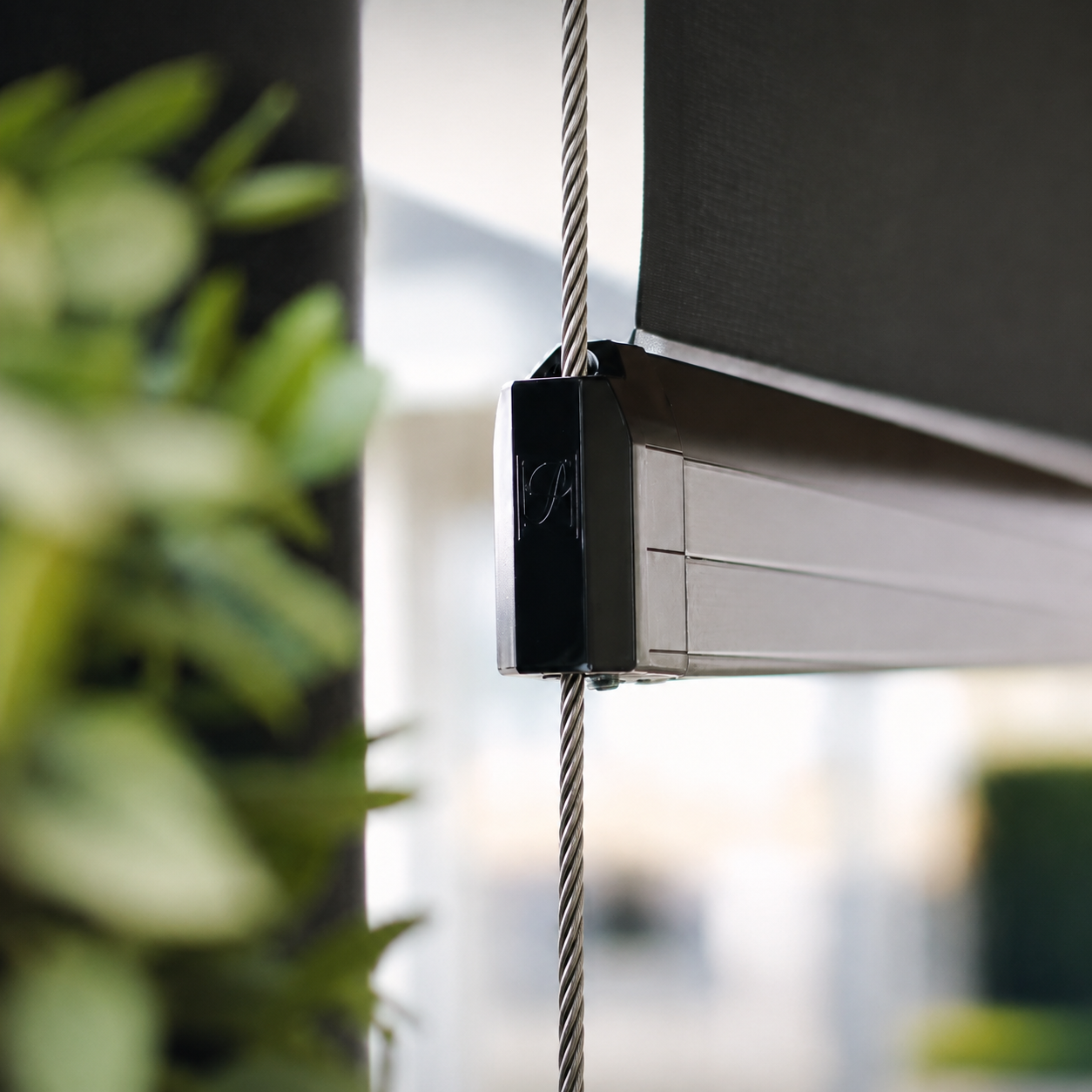
Most homeowners who research retractable screens encounter two distinct system types before they realize they are looking at different products. A track-based motorized screen mounts its mesh between side tracks on both edges of the opening. A cable guide motorized screen uses self-tensioning stainless steel cables instead of tracks, anchored at the top in the housing unit and at the bottom into the wall or floor. The screen travels along the cables rather than inside a rigid track channel.
The distinction matters because the right choice depends entirely on what your opening looks like. If you have solid structural supports on both sides of the opening, a track system is the standard and appropriate choice. If you have an open corner, a decorative column, a large picture window without adjacent side walls, or an opening where you want the screen mounted on the exterior of the building, a cable guide is what makes the installation possible.
The Specific Problem Cable Guide Solves
A track-based screen requires a surface or structure on both sides of the opening to mount the guide rails. For most door and patio openings, those side surfaces exist: the door frame, the patio post, or the structural wall on each side. For many of the outdoor configurations common in Southern California, they do not.
A pergola with decorative columns rather than solid posts presents an open-corner problem. A large picture window on an exterior wall with no adjacent structural supports on either side cannot anchor standard side tracks. A covered outdoor space with open corners where two planes meet without a post has no mounting surface for a traditional track. An exterior solar shade application, where the screen mounts on the outside face of the building above a large window, has no side structure to receive tracks.
In each of these situations, a cable guide system is the solution. The self-tensioning technology keeps the cables taut in varying outdoor conditions, eliminating the need for posts or tracks while maintaining consistent screen tension. The screen deploys and retracts cleanly along the cables and disappears into its housing when not in use, exactly as a track-based system does.
Cable Guide vs. Track: Choosing the Right System
Understanding which system your project needs comes down to two questions: what does the structure around your opening look like, and what is the primary function you need the screen to perform?
When a track system is the right choice: Standard door openings, patio enclosures with structural posts or walls on both sides, covered outdoor areas with side supports, and any application where insect protection is the primary need. A track system creates a tighter perimeter seal along the edges of the mesh, which is what produces effective insect control. If keeping insects out is as important as sun management, a track-based installation is the appropriate specification.
When a cable guide is the right choice: Open-corner configurations, decorative column installations, large picture windows without adjacent side supports, pergola spaces where standard tracks cannot anchor, and exterior solar shade applications on the outside face of a building. The cable guide makes these installations possible where a track system simply cannot mount.
Phantom's cable guide motorized screens accommodate openings up to 300 inches wide, which at 25 feet spans the large picture window and open-corner configurations common in contemporary Southern California estate construction. Maximum height reaches 240 inches, covering the tall exterior wall applications where solar shading is the primary function.
The Exterior Solar Shade Application
One of the most valuable applications for the cable guide system is exterior solar shading on the outside face of large windows and glass wall systems. This is a specific use case that a standard track-based patio screen does not address.
Mounting to the home's exterior is 7 times more effective at reducing heat gain than interior shades. Interior blinds, shades, and roller systems intercept solar radiation after it has already passed through the glass and entered the room as heat. An exterior screen intercepts that radiation before it reaches the glass, which is where the measurable difference in heat gain reduction occurs. For Southern California homes where the U.S. Department of Energy confirms windows and glass doors account for 25 to 30% of residential heating and cooling energy use, an exterior-mounted cable guide screen on a large south or west-facing window is one of the highest-impact energy management additions available.
The cable guide makes this exterior mounting possible on large windows that have no adjacent side structures to anchor a track system. The cables anchor at the top housing and at the bottom into the wall or floor on either side of the window, and the screen deploys across the exterior face of the glass without requiring structural supports at the window's edges.
Specific Southern California Applications
Large picture windows in contemporary estates. The contemporary architecture common across Beverly Hills, Bel Air, Hidden Hills, and the Santa Monica Mountains corridor features large glass wall sections and picture windows designed to maximize hillside and valley views. Many of these windows are flanked by stucco or stone wall surfaces rather than structural posts, making a cable guide the appropriate system for exterior solar shading on those openings.
Open-corner pergolas and covered outdoor spaces. Pergolas with decorative columns rather than solid posts, covered outdoor dining areas with open corners, and freestanding structures positioned away from the home all present the specific mounting challenge the cable guide addresses. Phantom's cable guide system installs on pergola spaces and covered outdoor areas without requiring extra support beams or structures, making it the appropriate specification for these configurations across Canyon Country, Calabasas, and Palos Verdes estate properties.
Covered pool areas and lanai spaces. Pool-adjacent covered structures with open-corner configurations where track installation is not structurally feasible benefit from cable guide systems for solar protection and privacy screening during peak afternoon hours.
Exterior solar shading in Encino, Calabasas, and the inland valley. For the inland valley communities where NASA research has documented peak land surface temperatures reaching 128 degrees Fahrenheit during extreme heat events, exterior solar shading on south and west-facing glass is one of the most practical interventions available for reducing afternoon heat gain. Cable guide systems make this exterior mounting possible on large window configurations that cannot accommodate a track system.
Mounting Options and Smart Home Integration
Phantom's cable guide system offers two mounting approaches: wall mount and floor mount. Wall mount anchors the bottom cables to the adjacent wall surface. Floor mount anchors directly into the floor or deck surface. The appropriate choice depends on the specific structure and what surfaces are available for anchoring at the base of the installation.
Control options mirror the track-based motorized system. Phantom has partnered with Somfy to provide the Maestria 50 RTS motor for cable guide installations, which includes obstacle detection and automatic adjustment. Sun and wind sensors allow the screen to deploy and retract automatically based on real-time conditions. Smart home integration with Lutron, Crestron, and smartphone devices means cable guide screens can be incorporated into the same scenes and schedules that manage the rest of the home's automated systems.
Santa Ana events occur 10 to 25 times annually in Southern California's inland and foothill communities. A wind sensor configured to retract the cable guide screen when gusts exceed a set threshold protects the installation during high-wind conditions without requiring the homeowner to monitor conditions manually.
Mesh Options for Cable Guide Installations
The mesh selection for a cable guide installation follows the same logic as any other motorized screen, with one practical distinction: because the cable guide is used primarily for solar protection and privacy applications on large exterior-facing openings, solar mesh and privacy mesh are the most common specifications.
Phantom offers solar mesh options including Phifer SunTex 80, which provides up to 80% heat blockage and 75% UV blocking at 25% openness, maintaining outward visibility while managing heat gain. Privacy mesh options including Phifer SheerWeave 2500 at 1% openness provide up to 99% UV blocking for applications where visual privacy from the street or neighboring properties is the primary goal alongside sun management.
Insect mesh options including Phifer TuffScreen are also available for cable guide installations where insect control is a secondary consideration alongside solar management. For applications where insect exclusion is the primary need and a structural side support exists, a track-based system is the more appropriate specification.
At Phantom Retractable Screens, our factory-trained local team serves Beverly Hills, Bel Air, Hidden Hills, Calabasas, Encino, Canyon Country, Palos Verdes, and the surrounding communities of Los Angeles, Orange, and Ventura Counties. Every cable guide installation begins with an on-site assessment that evaluates the structural configuration of your opening, the mounting surfaces available for cable anchoring, and the primary function the screen needs to perform. Wall mount and floor mount options, full smart home integration with Somfy, Lutron, and Crestron, and the complete Phantom mesh selection are all available for cable guide installations. Our cable guide motorized screen systems accommodate openings up to 300 inches wide and 240 inches tall. Every installation is backed by a limited lifetime component warranty, a 7-year motor warranty, and a 24-month labor warranty. Screen mesh is not included under the component warranty, but it can always be repaired or replaced if needed.
Request a consultation and one of our local specialists will assess your specific opening configuration and confirm whether a cable guide or track-based system is the right specification for your project.
Frequently Asked Questions
What is the difference between a cable guide screen and a track-based screen? A track-based screen uses rigid guide rails mounted on both sides of the opening to direct the mesh as it deploys and retracts. A cable guide screen uses self-tensioning stainless steel cables anchored at the housing and at the base, allowing the mesh to travel along the cables without requiring structural side supports. The cable guide makes installation possible in open-corner configurations, on large windows without adjacent side walls, and for exterior solar shade applications where a track system cannot be anchored.
When should I use a cable guide instead of a track system? Use a cable guide when the opening has no structural side supports for track mounting: open-corner pergolas, decorative column configurations, large picture windows without adjacent walls, or exterior solar shade applications on the outside face of a building. Use a track system when side supports are available and insect exclusion is a primary function, since the track creates a tighter perimeter seal along the mesh edges.
Can a cable guide screen be used for insect protection? Insect mesh options are available for cable guide installations. However, for applications where insect exclusion is the primary function and structural side supports are available, a track-based system produces a tighter edge seal and is generally the more appropriate specification. Your installer can assess your specific situation and confirm the right system based on your primary functional needs.
How wide can a cable guide screen span? Phantom's cable guide motorized screens accommodate openings up to 300 inches (25 feet) wide and 240 inches tall. Size limitations exist based on width and height ratio, and your Phantom specialist will confirm feasibility based on your exact dimensions during the on-site assessment.
Can cable guide screens integrate with my smart home system? Yes. Phantom's cable guide motorized screens use the Somfy Maestria 50 RTS motor and integrate with Lutron, Crestron, and smartphone devices. Sun and wind sensors can be added to automate deployment and retraction based on real-time conditions. For properties with existing home automation infrastructure, screens integrate into the same system without requiring a separate control interface.
Tags
Written by
Phantom Retractable Screens Team
Custom retractable screen solutions for homes across Southern California.
Related Articles

Retractable Screens for Sliding Doors: Handle & Latch Guide
How Phantom retractable screens use a latch and release handle instead of magnets, covering independent panel operation, secure closure, and why it matters on single and double sliding patio doors.

Motorized Screens for Indoor-Outdoor Pool Designs in SoCal
How motorized retractable screens solve privacy, sun management, and insect control for indoor-outdoor pool enclosures on Southern California luxury estates with large structural openings.

Year-Round Outdoor Dining With Screens and Overhead Heat
How Southern California homeowners combine retractable screens and overhead infrared heaters to create outdoor dining rooms that are comfortable and usable every month of the year.
Interested in Retractable Screens?
Get a free quote for custom Phantom retractable screens — motorized, door, or window screens for your home.
Get a Free Quote